Get Your ESA Letter in Nevada – Licensed Mental Health Professional Evaluation
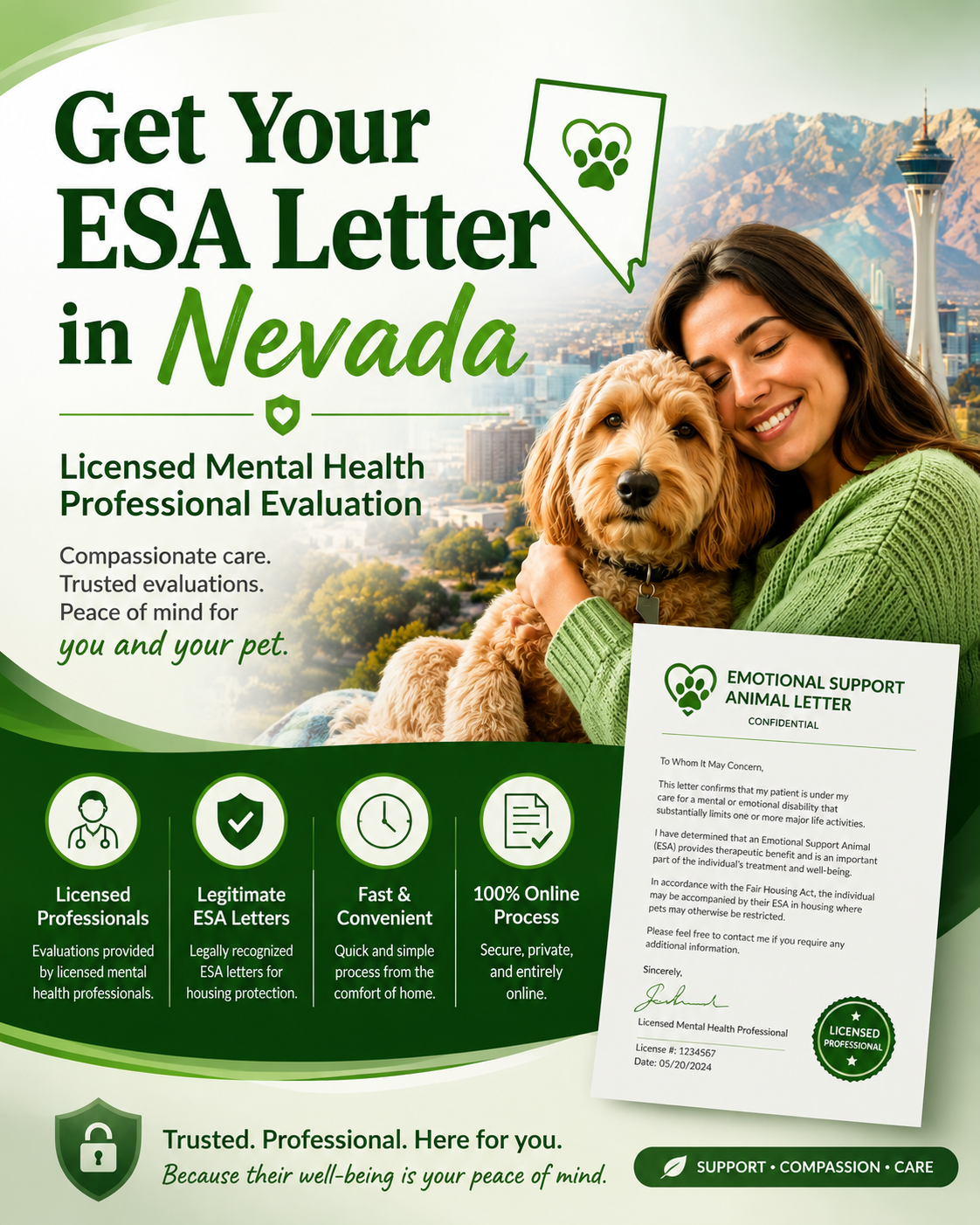
How to Get an Emotional Support Animal (ESA) Letter in Nevada
If you are a resident of Nevada and your pet helps you cope with anxiety, depression, and other challenging emotions and days, then there is one way to protect this unique relationship, including in situations in which pets are not allowed in housing at all. This way is called an Emotional Support Animal Letter, or ESA letter, and it is the only document that has any legal effect in this situation. It is neither a certificate, nor an ID card, nor any kind of registry.
This guide will answer all of your questions as a Nevada resident on this matter: what an ESA letter is, what Nevada and federal law say about ESA letters (especially taking into account an important update in 2026), what makes someone eligible for the letter, what the steps are for getting the legitimate letter, what it should contain, and what scams to avoid.
What Is an ESA Letter?
An ESA letter is a signed letter by a Licensed Mental Health Professional (LMHP), who is a therapist, counselor, psychologist, psychiatrist, or clinical social worker, indicating that there is a diagnosed mental or emotional condition and an ESA can reduce its symptoms. It should be issued on the clinician’s letterhead and contain his/her license number and contact information as the result of an actual assessment of the patient, and not because of an online questionnaire completed by a person.
It’s worth noting what an ESA letter isn’t. There is no ESA registry in the US. There is no state registry in Nevada. If someone offers you an ID card, a vest, or “registration” for your ESA, it’s completely irrelevant and legally meaningless – neither protects your animal nor forces a landlord to recognize the letter. All that counts is an actual letter from an LMHP.
What’s important, ESA doesn’t require any special training. In contrast to a service animal, which is trained to do certain tasks related to a disability, an ESA just provides comfort due to its presence. Therefore, any animal can be your ESA if a licensed professional finds that he/she meets your mental or emotional condition and the request is reasonable.
Nevada ESA Laws You Need to Know in 2026
Unlike the majority of other states, Nevada indeed has a special state housing statute, which supplements ESA protection: NRS 118.105. The law is drafted very broadly and includes animals “that assist, support, or provide service” to the owner, who suffers from any disability, so it obviously covers emotional support animals although this term is not used explicitly in the statute. ESA rights in Nevada originate from the following sources:
- The FHA – the federal Fair Housing Act, which obliges landlords to make reasonable accommodations for disabled tenants and allows having an ESA in a pet-free building without a deposit or pet rent.
- NRS 118.105 – Nevada state housing statute, which guarantees separate protection for ESA owners and enables landlords to ask for documentation (like your ESA letter) about the animal’s contribution to your condition.
- The ADA – the Americans with Disabilities Act, which concerns only service animals, but not ESAs. Emotional support animals have no rights regarding public access in Nevada; they can be protected only in housing.
Important information regarding a recent federal development: In May 2026, HUD’s Office of Fair Housing and Equal Opportunity adopted a new policy which generally limits federal enforcement of fair housing complaints involving ESAs to those individual animals which are trained to perform some sort of task, which has historically been applied exclusively to service animals. This represents a narrowing of federal enforcement policy but not a change to the Fair Housing Act itself. This impacts residents of Nevada less severely than individuals living in states without ESA legislation because NRS 118.105 offers independent protection for Nevadan ESA owners regardless of HUD’s enforcement policies and the Nevada Equal Rights Commission (NERC) independently investigates housing discrimination complaints. It is also possible to file a private action based on the federal FHA. In other words, a legitimate ESA letter written by a licensed Nevadan healthcare provider has legal weight as far as housing is concerned in Nevada.
Residents of Nevada with an ESA letter may:
- live in “no pets” property free of pet fees, pet rent, and a pet deposit
- have their landlord classify the animal as an aspect of medical accommodation rather than a pet
- escape breed or weight restrictions
- rely both on the state statute (NRS 118.105) and federal law when negotiating with a landlord
Additionally, it is important to know that Nevada takes ESA misuse seriously: it is a misdemeanor offense to misrepresent the ESA as a trained service animal for the purpose of gaining rights of public access it does not have, and it is a gross misdemeanor offense of fraudulently obtaining disability-related services, which is punishable with imprisonment and fines.
How to Get an ESA Letter in Nevada: Step-by-Step
Getting a legitimate ESA letter in Nevada generally follows the same process regardless of which licensed provider you choose:
Step 1: Complete a pre-screening or intake assessment
Typically, the best and most respectable telehealth ESA services start with a brief questionnaire regarding your symptoms, living environment, and how the animal helps you. This isn't a diagnosis – it's just a way to determine which licensed mental health professional is a good fit for your case.
Step 2: Have a live consultation with a licensed mental health professional
It's a mandatory step according to both federal guidelines and general clinical practice. A live consultation over the phone, via video chat, or even in person is required before issuing an ESA letter. If a company avoids this step and only sends you a letter following a brief online questionnaire, there's no chance that such a document will be valid or recognized.
Step 3: Receive your signed ESA letter
Should you be considered eligible by the clinician, you will usually get the letter in 15 minutes, using a secure online platform. The document should have the letterhead of the clinician, his license number, contact information, and the statement that says you meet the qualifications to be eligible for an ESA. The moment you get the letter, you don't need a certain breed or a certain breeder; you just choose the animal (current or new adoption) as your ESA.
How to Get an ESA Letter in Nevada: Step-by-Step
Besides the legal rights for housing protection, there are several benefits of the human-animal relationship which help people to deal with their mental health issues:
Offers psychological support
Either by providing companionship or just showing affection, an ESA can significantly help a person in dealing with anxiety, depression, or trauma recovery.
Can relieve the symptoms of anxiety and depression.
For a lot of people, the comfort provided by the pet during hard times acts as another coping mechanism along with others.
Can contribute to creating a positive daily schedule.
Caring for an animal is something that gives structure to a person's day.
Reduces stress levels.
The physical touch from a pet, such as petting or cuddling, helps to lower cortisol levels and relax.
Promotes physical exercise and socialization.
Owning an emotional support pet means walking the dog each day and thus exercising and meeting new people.
Complements the treatment program.
An ESA does not replace therapy and medications but can be used as an additional element of a coping strategy.

Nevada ESA Letter
Why choose us
Licensed Nevada Professionals: Connect with licensed mental health professionals familiar with Nevada requirements for Emotional Support Animal (ESA) letters.
Convenient Online Evaluations: Complete your ESA evaluation online from the comfort of your home with a simple, convenient process.
Secure & Confidential: Your personal information and evaluation are handled with privacy and confidentiality throughout the process.
Personalized Support: Every ESA evaluation is based on your individual circumstances, helping ensure your Nevada ESA letter reflects your specific needs.
What Should Be in a Legitimate Nevada ESA Letter
A properly written ESA letter should always include:
- The mental health professional’s official letterhead
- Their license number, license type, and contact information (so a landlord can verify it)
- The date the letter was issued
- A statement confirming that you meet the definition of a disability under the Fair Housing Act
- A clear recommendation that an emotional support animal is part of your treatment plan
If any of these elements is missing – especially the license number or evidence of a live evaluation – that’s a strong signal the provider isn’t operating within legal requirements.
Benefits of Having an ESA in Nevada
Besides the legal rights for housing protection, there are several benefits of the human-animal relationship which help people to deal with their mental health issues:
- Offers psychological support. Either by providing companionship or just showing affection, an ESA can significantly help a person in dealing with anxiety, depression, or trauma recovery.
- Can relieve the symptoms of anxiety and depression. For a lot of people, the comfort provided by the pet during hard times acts as another coping mechanism along with others.
- Can contribute to creating a positive daily schedule. Caring for an animal is something that gives structure to a person’s day.
- Reduces stress levels. The physical touch from a pet, such as petting or cuddling, helps to lower cortisol levels and relax.
- Promotes physical exercise and socialization. Owning a emotional support pet means walking the dog each day and thus exercising and meeting new people.
- Complements the treatment program. An ESA does not replace therapy and medications but can be used as an additional element of a coping strategy.
ESA vs. Psychiatric Service Dog (PSD): What’s the Difference?
The difference confuses many people, and this is because the two animals come with different legal rights:
- Emotional Support Animals (ESA) provide emotional support simply by their presence without requiring any form of specialized training. Their legal rights are confined to being permitted in housing under the Federal Fair Housing Act and Nevada NRS 118.105.
- Psychiatric Service Dog (PSD), on the other hand, is trained to help with carrying out certain tasks to mitigate the effects of psychiatric disabilities of a person, such as interrupting a panic attack, deep pressure therapy, or reminding a person to take medications. The dog is considered to have been trained to carry out work, hence qualifies under ADA and the Public Accommodation provisions where they have rights to be with the person in public places, on flights, and in the work environment.
Where you require assistance outside the home, like during travel, then the PSD could be more suitable, and this involves training the dog with task-specific functions related to your disability.
Common ESA Myths in Nevada
Here are some of the myths about ESAs that you should know about:
- “ESAs are like service animals.” That’s not how they work. ESAs offer emotional support but are not specifically trained for anything, nor do they have the public access rights that service animals have according to ADA laws.
- “I have to register my ESA in the registry.” There is no such thing – not federally and not in Nevada either. Sites that sell you ESA registration or ID cards have nothing of legal significance. All that is necessary is a valid letter from a licensed mental health care provider.
- “Landlords have the right to reject ESAs.” Not without a good reason. Refusing to accept a properly authorized ESA without justifiable reasons will result in being sued for housing discrimination by the provisions of the Fair Housing Act and NRS 118.105.
- “Online ESA letter companies are all scams.” It’s not true – there are some, however. A reputable company will provide you with a genuine mental health provider based in Nevada, with whom you’ll complete an evaluation via telehealth. A company skipping this part altogether is where the scam lies.
How to Spot an ESA Letter Scam in Nevada?
With the level of fraud that has been witnessed in this area, in addition to the penalties attached by Nevada for ESA misrepresentation, it will be prudent to note the red flags before paying for anything:
- No face-to-face consultation. Any service that uses a questionnaire online and does not conduct a consultation via phone or video with a qualified clinician should not be trusted.
- Vague or missing license details. An authentic letter will always have the name of the clinician, his/her license number, and the license type, which can be verified by the landlord.
- Offers “registration,” certificates, or ID kits. This is not legally valid and may mean that the company has nothing else to offer apart from upselling its services.
- Does not provide a refund option in case you do not qualify. This is an indication of an unreliable provider.
What to Do If Your Landlord Questions Your ESA Letter In Nevada
Even with a legitimate letter, some landlords might refuse – either due to their misunderstanding of the situation or unwillingness to have pets around. However, in accordance with the laws of Nevada, landlords are allowed to request certain documentation; thus, knowing what is acceptable and what is not is essential:
- Direct attention to the letter. The legitimate letter contains the license number and contact information of a licensed professional in order for the landlord to be able to verify it. Ask your landlord to contact your licensed professional with any questions.
- Refer to the laws of Nevada and the Fair Housing Act (FHA). According to the laws of Nevada, it is perfectly fine for a landlord to request documents proving that the pet you own provides assistance to you in dealing with a disability. Your letter is enough.
- Know what they should not ask. The landlord is not supposed to ask for your complete medical records or any particular diagnosis. All he or she needs is documentation from a licensed professional.
- Take legal action if needed. If the landlord keeps on refusing to give consent on legitimate grounds, then you can submit an official complaint with the Nevada Equal Rights Commission (NERC) or HUD.
Renewing Your ESA Letter in Nevada
Despite the absence of an expiration period defined by the Fair Housing Act or even Nevada laws regarding ESA letters, it is still highly advisable for you to renew your ESA letter annually. The reason behind this advice is the fact that landlords tend to recognize the relevance of recently issued letters better, and clinicians are unlikely to verify your letter if it was written several years ago.
Frequently Asked Questions About Nevada ESA letter
Is an ESA letter legal in Nevada?
Yes. An ESA letter issued by a licensed psychologist falls within the ambit of both the federal Fair Housing Act and state law NRS 118.105 of Nevada. It allows landlords to make reasonable accommodations even when there is a “no pets” policy and bars the imposition of additional costs for a genuine ESA.
Can I get an ESA letter for a pet I already own?
Yes. There is no need to find a new pet. No matter what breed or species it is, as long as a licensed healthcare provider deems it necessary for your mental or psychological well-being.
Do ESAs have public access rights in Nevada?
No. They are granted protection in housing only and do not have any access rights in places like restaurants, stores, and public transport. It is only service animals, under the ADA, that can do so in Nevada.
How long does it take to get an ESA letter in Nevada?
Generally, any legal telehealth provider provides a letter within 15 minutes upon completion of a live consultation with a licensed professional, provided that you are eligible for it. Some providers provide services that allow receiving a letter on the very same day.
Can a Nevada landlord deny my ESA?
Yes, but only based on legitimate grounds, for example, if there is a real danger to your safety or undue burden. The refusal by a landlord for a legitimate request may be against the law, including the Fair Housing Act and NRS 118.105.
Do I need to renew my Nevada ESA letter every year?
Yes, annual renewal is strongly recommended. It keeps your ESA letter valid make, sure your clinician can verify it if contacted via landlords, and reflects your ongoing, present need for and ESA.
Schedule Telemedicine Appointment
Connect with our board-certified doctors through our easy-to-use telemedicine platform. We offer personalized consultations designed to fit your unique health needs, all while ensuring your privacy and convenience.
Expert Care at Your Fingertips
24/7 Availability for Your Peace of Mind